Invitation to the 6th Planetary Aeronomy, Magnetism, and Space Weather Annual Conference (PAMSAC) Background

 The Space and Planetary Science (SPS) research division at the Space Science and Geospatial Institute (SSGI), in collaboration with national and international institutions and universities, has successfully hosted the Space and Planetary Sciences Conference (SPSC) for the past four consecutive years. The conference series aims to bring together researchers, engineers, and leading scientists to share recent advancements and foster collaboration in space, planetary, and atmospheric sciences. In 2024, the SPS research division rebranded the conference as the PAMSAC to better reflect its evolving scientific focus.
Objectives of the conference
- Facilitate Knowledge Exchange: Provide a platform for participants to present their research findings and technological advancements.
- Promote Interdisciplinary Collaboration: Encourage networking and partnerships among scientists, industry professionals, and policymakers.
- Develop Actionable Recommendations: Create a set of recommendations and best practices that can influence future research and policy in space and planetary sciences.
Conference thematic areas
- Ionospheric and Thermospheric Dynamics
- Coupling between the ionosphere and thermosphere
- Ionospheric irregularities, scintillation and plasma instabilities
- Lower–upper atmospheric coupling (tides, gravity waves, planetary waves)
- Thermospheric winds, temperatures, and density variability
- Ionospheric electrodynamics and plasma transport processes
- Observational and modeling studies of ionosphere–thermosphere interactions
- Machine learning and AI-based approaches
- Equatorial, midlatitude, and high-latitude ionospheric dynamics
- Geomagnetism
- Earth’s main magnetic field and secular variation
- Geomagnetic storms and substorms
- Magnetic field measurements from ground-based and satellite observations
- Modeling and simulation of geomagnetic field variations
- Applications of geomagnetism in navigation and geophysical exploration
- Magnetosphere and plasma physics
- Structure and dynamics of the Earth’s magnetosphere
- Solar wind–magnetosphere interactions
- Magnetic reconnection and energy transfer processes
- Satellite and ground-based observations of magnetospheric plasma
- Radiation belts and ring current dynamics
- Atmosphere –ionosphere- magnetosphere coupling
- Energy and momentum transfer across atmospheric, ionospheric, and magnetospheric regions
- Electrodynamic coupling processes
- Magnetosphere–ionosphere current systems
- Observational studies of coupled atmosphere–ionosphere–magnetosphere dynamics
- Modeling and data assimilation of the coupled system
- Heliospheric physics
- Solar EUV and X-ray variability
- Solar flares and coronal mass ejections (CMEs)
- Structure and dynamics of the heliosphere
- Solar wind origin, acceleration, and variability
- Heliospheric current sheet and sector structure
- Modeling and simulation of heliospheric processes
- Interplanetary magnetic field and turbulence
- Space Weather and Its Technological Impacts (focus on equatorial region)
- Solar–terrestrial interactions and geomagnetic storms
- Space weather effects on GNSS, HF communication, and navigation
- AI and machine learning applications in space weather prediction
- Data assimilation approaches in space weather
- Space weather monitoring, forecasting, and modeling
- Power grid disturbances and ground-induced currents
- Unique characteristics of equatorial space weather processes
- Equatorial ionospheric electrodynamics (EEJ, PRE)
- Equatorial plasma irregularities and scintillation
- Equatorial spread F and plasma bubble dynamics
- Observations and modeling of equatorial space weather
- Mitigation strategies for space weather effects in equatorial regions
- Planetary Atmospheres, Ionosphere and Magnetosphere
- Structure and composition of planetary atmospheres
- Planetary ionospheres and plasma environments
- Solar wind interactions with planetary environments
- Modeling of planetary atmosphere–ionosphere–magnetosphere systems
- Coupling processes in planetary environments
Conference location and schedule
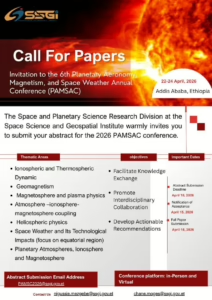
The 6th PAMSAC will be held in Addis Ababa, Ethiopia, from April 22 to 24, 2026.
Conference platform
PAMSAC 2026 will be a hybrid conference, offering both in-person and virtual participation.
Abstract submission format and deadline
The abstracts should have names of author and coauthors, their respective affiliations and abstract content with not more than 250 words. The abstracts submitted after April 10,2026 may not be guaranteed for confirmation.
Contact:
- For abstract submission, please use the email address: PAMSC2026@ssgi.gov.et
- For any questions or concerns, please contact the following personal email addresses:
- Nigussie Mezgebe (PhD) : nigussie.mezgebe@ssgi.gov.et
- Chane Moges (PhD) : chane.moges@ssgi.gov.et
Expected Audience and Participants
This conference is designed for a diverse audience, including researchers at all stages of their careers, scientists, engineers, and professionals engaged in space, planetary, and atmospheric sciences and their applications. It will also attract space enthusiasts and anyone with a keen interest in these fields.
Comments are closed, but trackbacks and pingbacks are open.